There’s Formation Flying and Then There’s Dissimilar Formation Flying…
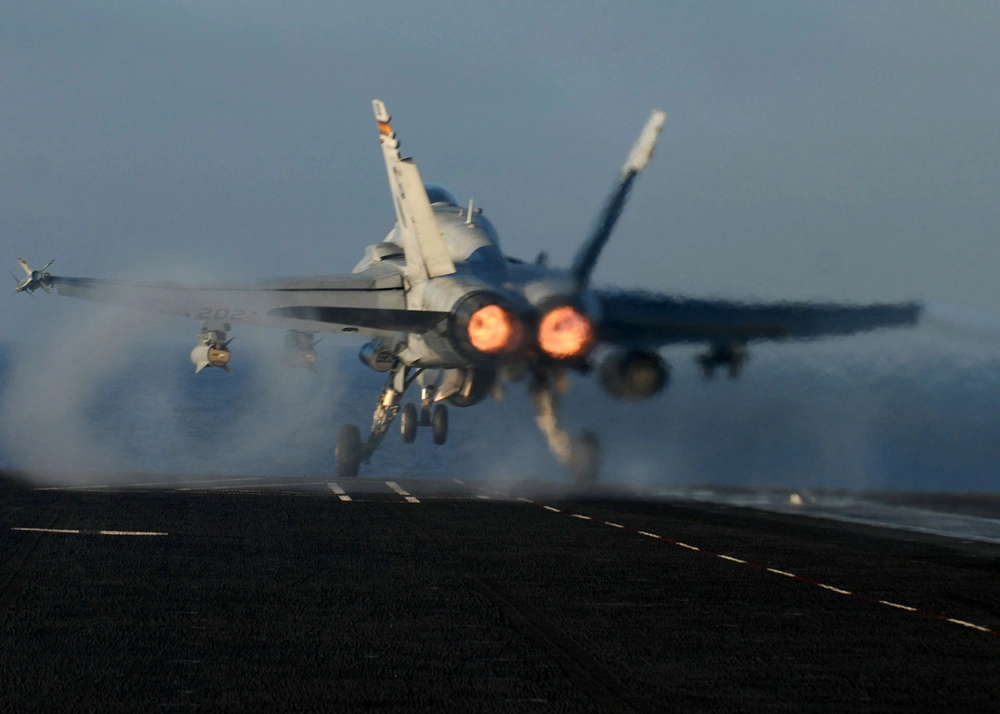
For those of us with double anchors on our wings, we were introduced to the concepts of formation flying about mid-way through the Basic phase of flight training, getting our first of a handful of what were affectionately known as “barf hops.” Naval Aviators, on the other hand, get introduced to the gentle art early and often, because for most tactical aircraft, formation flights are the rule, not the exception. One flies in formations of various numbers and arrangements for as long as one gets to avoid adulthood stay in the cockpit. As one progresses, and especially because we really, really enjoy it when the “home fires” in the engine(s) keep burning where they’re supposed to, we by necessity learned to fly formation on the airborne tanker, be it a similar bird armed with a “buddy store” or dragging an internal hose (outside of the KC-10, pretty much extinct these days) or “another guy” who’s job is “pass gas” as the need arises. Sometimes, when stacked overhead the boat, waiting for one’s turn to return to where the food is, you’ll be joined by “some other guys” although these days that’s getting increasingly rare, as it seems like out side of a couple of Grumman products, it’s all a mass of Bugs.
Civilians, on the other hand, besides a few aerial demonstration displays, don’t do formation much. When they do, it’s usually the same type of aircraft, be it older warbirds or general aviation planes. What you don’t usually get, is something like this:

Take a minute to look at that picture, taken, well honestly, more than a few years ago. Yes, that’s a pre-WWII twin Lockheed leading the crowd. With a DC-3, a radial-engined Convair with a turbo-prop conversion Convair and a DC-9. Yes, a DC-9. Jet-powered DC-9. That, dear friends, is what we call dissimilar formation flying! To take the rest of the way for the story-behind-the-picture, I leave you in the very, very capable hands of one my good friends and a guy who literally was flying before your Most Humble and Obedient Servant was born, Randy L. Sohn:(and yes, I do happen to have his permission)
“FORMATION PHOTO OF WISCONSIN CENTRAL-NORTH CENTRAL AIRLINERS
This photograph has been displayed and found its way into so many aviation publications over the years that it’s practically become an icon. Several people have told me that I need to write exactly how it all really happened. It all started when I became aware that Lee Koepke (a North Central Airlines lead mechanic in Detroit and also the owner of an aircraft maintenance school) was considering selling the twin engine Lockheed Electra 10A airplane that he’d restored to an air museum in Ottawa (where the aircraft still exists). Incidentally (and, while not germane to this story), this is the same airplane that Ann and Lee Pellegrino flew around the world in 1967 to retrace the route taken by Amelia Earhart).
It’d previously been the first new aircraft that Trans-Canada Airlines had purchased; it bore the registration of CF-TCA while in that fleet during the late 1930s. North Central (in its earlier days as Wisconsin Central) had subsequently operated this very aircraft as NC79237. Many’s the time that I’d heard reminiscences about those bygone days and airplanes from Art Hinke, our grizzled chief pilot, who’d flown them in those days. He’d told me of the lean economic times when the airline could only afford to paint one side of the airplane (facing the camera) for a publicity photo. It occurred to me that this would present another opportunity to save some of the repainting expense if we could obtain use of the aircraft for a few days in order to photograph a formation of all the airliner types that the company had ever operated. At that time, we were still flying the Douglas DC-3s along with the reciprocating engine Convairs but were rapidly replacing both with freshly converted Convair 580s and newly acquired Douglas DC-9s. Upon giving the matter some thought, I realized that this probably represented a unique opportunity (AND one only possible for a limited time) of flying all these aircraft in formation and photographing this historic event. It’d also coincide with the twentieth anniversary of the airline’s first scheduled flight.
A few days later, I happened to attend a Christmas party given by our Minneapolis-St. Paul maintenance department. Hal Carr, our airline’s president, was also present at that evening’s gathering. Accordingly, I used the opportunity to present the scenario described above to Mr. Carr. His immediate reaction was that, since there was a great difference in the aircraft’s airspeeds, the formation wouldn’t work! My reply was ”Well, if I can choose the pilots, it will work”. After some further discussion of the proposal he responded with a “Well, go ahead – but if it doesn’t work, you’re fired”.
In the next couple of days, I’d discussed the matter with the airline’s maintenance department who agreed to paint the aircraft in the livery worn while in Wisconsin Central’s service. I also contacted the five pilots we’d need, all of them highly competent and possessing previous formation experience. Our airline’s chief pilot, Art Hinke, was a natural selection to fly the Lockheed, considering his USN experience and the fact that he’d flown the aircraft extensively in the airline’s early days. He decided to have Bob Murphy, one of our most senior check pilots, accompany him. At the other end of the formation would be the DC-9. Our V/P of Flight Operations, G.F. Wallis, was uniquely qualified to handle those duties considering his previous USMC Corsair experiences. Red selected my boss in the airline’s Flight Training Dept., Pete Wahl, to accompany him. Pete also possessed an extensive military history in B-24s, B-29s and others. Another USMC veteran, our chief pilot of the MSP pilot base, Louie Farrell, would fly the DC-3 and he’d take along Ret Thompson. Charlie Timberg, formerly a USN pilot and, most recently, a pilot with us in the Minnesota Air National Guard, would fly the Convair 440, along with Greg Meitrodt. Len Dolny, with extensive experience in the F-86 Sabrejet while in the USAF – and now one of our check pilots – would fly the 580, taking along Wayne Palon, another check pilot. We’d also need another airplane, a chase 580, to carry the photographers. Fortunately, just a short time prior to this, we’d received one back from the Pac-Aero Corp. who’d accomplished the conversions to turbo-props under a contract with the Allison Div. of General Motors Corp. Since all this took place in the middle of the winter, I realized that the flight would be extremely cold. Therefore, I started to gather all the cold weather flying apparel I could find. I asked one of our check pilots, Bert Anderson, one of the smoothest pilots that I’d ever flown with, to come along with me. He also endeavored to collect all the cold weather flying gear he could possibly lay his hands on.
Word of this proposed flight rapidly spread among the contingent of photographers in the Twin Cities (Minneapolis-St. Paul) area. One of the highly competent people that contacted me wanting to participate was Sherm Booen, a veteran of WCCO’s radio and TV stations. Another was Lt. Col. Forrest Sorenson from the Minnesota Air National Guard. One of our own pilots who immediately told me of his desire to be included was Bob Smith, a highly acclaimed expert with a camera. I seem to recollect that, ultimately; sixteen photographers boarded the 580 with us that morning. The 580 that we’d use as a chase airplane had only been returned to us a few days previously, it was (to say the least) a “bare-bones” aircraft. The old interior’s upholstery fabric had been baked by the sun at the Burbank tarmac during those months it’d spent out in California during the conversion process. The maintenance department had removed many of the cabin’s windows to allow the photographers a clear (unimpeded by glass) view of the other aircraft in formation. In addition, all the cabin emergency exits had been removed so the main cabin was devoid of both windows and glass in about half of the fuselage’s openings.
The Lockheed had been ferried over from Detroit to our airline’s headquarters at Wold-Chamberlain a few days prior to the date of the flight and the maintenance department then set about the task of repainting it in the original paint scheme. As best I recall, the famous “blue goose” insignia was a maroon color, as per the original, instead of the later dark blue of this rather famous airline logo. The day prior to the formation flight Art Hinke decided to take that aircraft for a short test flight and asked me to accompany him. The strongest memory I have of that flight was the extremely high noise level we experienced in the cockpit, compared to aircraft manufactured only a few years later
The February morning of that formation flight dawned clear and cold. I don’t recall the exact temperature; however, the photographs show that snow covered the ground. I also don’t recall this part but photos that were taken before the flight that morning indicate that the airplanes were towed to or placed in alignment on the old terminal’s ramp on the west side of the airport. The pilots (with their overcoats on – did I mention that it was cold?) briefly posed for a “posterity record” type photograph before boarding their aircraft. Another thing caused a sharp jog in my memory of that event when I reviewed those photos a few days ago, seeing those USN P2V aircraft in the background of those old photographs of the formation’s pilots and airplanes. The naval reserve base at that time was located on the airport’s north side.
After we’d finished a final briefing, Art took off first and proceeded to an area northwest of here, one well outside the area congested with air traffic. After Bert and I’d taken off in that converted 580, I remember that as Bert retracted the wing flaps upon my command, the rotten and old cotton headliner made sort of a sickening “whoosh” noise as it was suddenly sucked out through the openings in the cabin, disappearing as we passed over Richfield. After flying to the designated area, Art leveled off at an altitude that furnished smooth air. We’d all agreed that he would lead the formation with the Lockheed’s engines set to METO (Maximum Except for Takeoff) power. Simply stated, this power setting meant that it could be maintained for the entire flight, any higher settings would mean that there would be a time limit at that high power. This resulted in an indicated airspeed of about 145 knots; therefore, that’s the speed the formation used for the entire period. This, inevitably, brings up the oft-expressed opinion of many that view the photo for the first time. “It’s altered/photoshopped, those airplanes didn’t really do that”. I’d guess that you could ask any of the participants, they know the truth; it was done. All one really needs to do is to look at the angles of attack of those aircraft. Notice that the Lockheed’s nose is way down while, at the other end of the formation, the DC-9’s is decidedly nose up. In addition, note that the DC-9’s leading edge devices (slats) are extended along with the corresponding amount of wing flaps in this configuration. It’s been several decades since I’ve flown the DC-9; however, I think I recall a minimum clean airspeed of about 200 knots without slats/flaps.
I recall a couple of things during that flight that probably could be considered unusual and requiring some extra effort. The first was to attempt to constantly place us in a position relative to the formation that’d allow the photographers the best viewing angles. To accomplish this the position of the sun also needed to be constantly considered. I recall that the openings in the aft part of the cabin worked best since they weren’t obstructed by the wing. Almost immediately, I found that I needed to feather the propeller on the formation side of the airplane in order to prevent any visible exhaust heat waves in the photos. This added to the difficulty of flying formation, requiring it to be flown “over-my-shoulder” while simultaneously contending with the yawing motion. To furnish even more problems, every time I’d change position relative to the formation in order to take advantage of the sun’s angle, I needed to restart one engine and then shut-down and feather the other. This necessitated, of course, having to quickly jump back and forth between both pilot seats in order to fly the position. Bert finally decided to stand in the cockpit’s entrance right behind the seats to accomplish what I’d asked – “really keep a sharp eye on what I do, lots of things happening and good chances here to really screw something up”. Another thing that I vividly remember is the loud noise emitted by the Lockheed’s two engines at METO power, audible to us even over the roar of our 580. Of course, as soon as one of our engines was shut down, the auxiliary AC cabin heater stopped. This immediately caused a frigid temperature situation aboard our unpressurized aircraft. Then, to add to our woes, the photographers began to complain that their film was freezing.
I believe that the formation flew northeast towards Duluth for a period, then reversed course and proceeded back towards the Twin Cities. The formation flew in both echelon and V shapes while we flew along with them with the photographer’s airplane to afford each the opportunity to get the views that they wanted. After that main event, we did do some individual and two-ship formations as per the photographer’s requests. Louie Farrell still has the record of this flight in his logbook and it shows that we flew for about two hours on that flight, and then returned for landing. The photos were later used in many publications and various forms of company publications. The photo that I personally always liked the best is the one that also seems to have been used subsequently in many books; it was taken by Forrest Sorenson. I’ve seen it in many locations and, if memory serves me correctly, I believe that Louie Farrell kept a framed copy in his office
Randy Sohn – 2012 ©”
Remember kids, don’t try this at home!