



Relaxed Stability
By lex, on January 13th, 2012
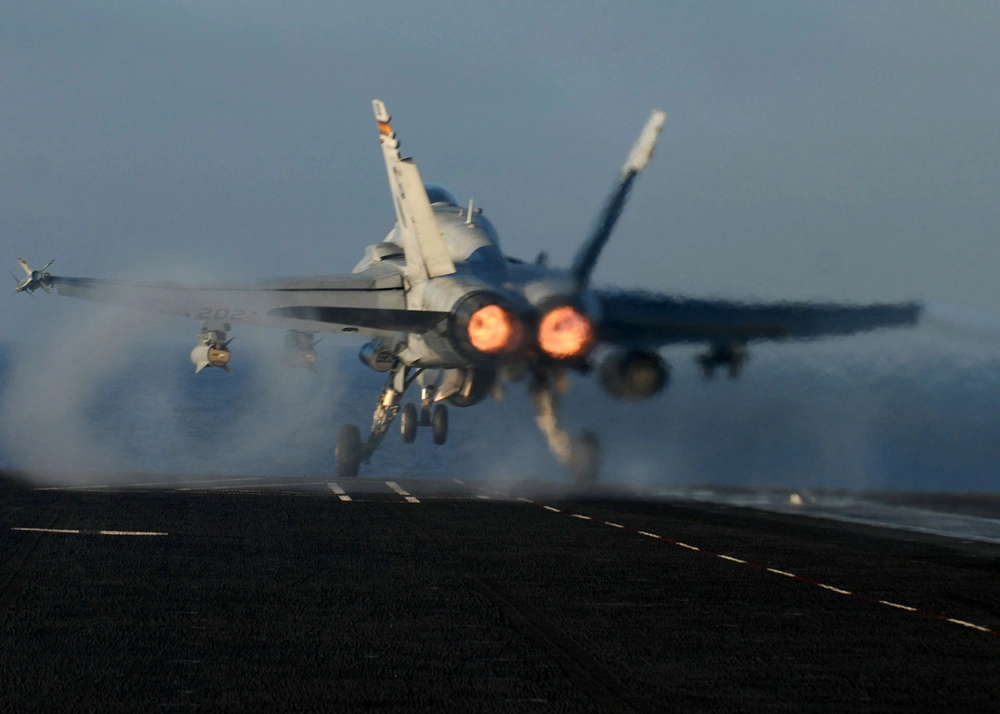
Two flights yesterday, one day and one night. In the day hop, we joined with two Marine FA-18s to serve as their wingmen for the adversary presentation. Merely maintaining formation and maneuvering mildly with the much more modern fighters vividly displayed what twenty years of fighter evolution can produce. A pair of medium bypass, afterburning fan engines, a model wing with automated high lift devices and digital flight controls can do things without trying that a J-79 engine mounted on a pure delta wing cannot, or at least, cannot do easily. I was in and out of afterburner just staying in position. Once the machine gets slow – anything less than 300 knots is officially “slow” – there’s just so much wing in the breeze, so much induced drag.
The later night flight was more or less inevitable, although we were at least graced by a “pinkie” launch, that is to say, one that benefited from the dwindling rays of the setting sun.
In 2001, I flew my first general aviation flight in years from NAS North Island in a T-41 Mescalaro, the USAF variant of the venerable Cessna 172. It was a club-owned aircraft, and I was determined at the time to keep my hand in the aviation world malgre the personal cost. What really opened my eyes on take-off was how quickly the machine got airborne, it seemed in just a couple of hundred feet – the FA-18, depending upon gross weight, takes around 2000 feet, the Kfir twice that, at least. I was also impressed, but in a far different way, with how slow she was to climb – perhaps a thousand feet per minute.
Fighter aircraft have comparatively massive amounts of pure thrust. But they are relatively heavy, and their wing designs, being optimized for high subsonic, supersonic and transonic flight, require higher true airspeeds before they can generate lift. Unlike the straight-wing Cessna and Piper designs however, once you get them airborne and get the landing gear up, they climb at high multiples of general aviation’s rate. Especially in full blower.
Heading to the range for during the day hop, I found myself focusing very closely on my instrument scan. I knew I’d need it when the night hop came around.
I’ve admitted this before, though it is against interest: I have never been terribly fond of flying at night.
Oh, it has its advantages. The air is generally smoother at night, and traffic is often easier to see. There are few distractions outside the cockpit on an inky dark night, like last night was. But very little reference to the ground, which is always there even when you cannot see it. And all the truly joyous elements of flying a fighter require reference to the horizon. Even night vision devices, while jolly to have in their own way – we have none – are pale substitutes. Only the sun can turn night into day.
The attitude indicators in the little Vargas I still occasionally fly on weekends have long ago given up the ghost. Their internal gyros were not built for swirling, 2-3 g dogfights. I cheerfully explain to guest pilots that, with the artificial horizons marked as inoperative, we would have no choice but to use the actual horizon. Which is, I routinely add, in any case far superior to the ersatz version.
A dark night, as I said. (How dark was it? It was darker than six feet up a cow’s a**. Darker than a hat full of a**holes. Darker than a witch’s dreams. Metaphors: I have dozens.) On a dark night, with no reference to the ocean, ground or sky, the attitude indicator becomes your slender grip on reality. You start your instrument scan with the AI as a control instrument, and then reference your performance instruments; airspeed indicator (or angle of attack), altimeter, vertical velocity indicator. This group gives you a sense of whether you are climbing or descending, how fast you are doing so, how fast you are going, and whether you are about to inadvertently stall (although stall in a swept-wing aircraft, unlike their more conventional straight-wing frères, is a tenuous concept – with sufficient thrust, even a brick can be made to fly. See also, the F-4 Phantom).
When basic aircraft vector is established, you then fold in your navigational instruments, which generally include some variant of a horizontal situation indicator, and vary from aircraft to aircraft, but which are always intended to display to you where you are, where you are going and – hopefully – where you ought to be going.
But always, everything begins and ends with the attitude indicator.
When you have a functioning three axis auto-pilot, coupled perhaps to your navigational instruments, flying at night or in instrument conditions becomes chiefly a systems management task: Desired courses are digitally entered, auto-throttles lock in your desired airspeed or AoA. In airliners, corporate jets and even some general aviation airplanes, rates of climb or descent can also be entered. Some aircraft can shoot instrument approaches and even land themselves. The Kfir does not abide within that stable.
It’s a hands-on machine, one of the last built before computerized flight controls were designed to ease the pilot’s workload. Like most fighters, it was built with relaxed stability in mind to make it more maneuverable. It does not self-correct. You must actively fly the machine.
Having had a bit of a break between flying in Fallon back in late November, I spent Wednesday breaking off the rust. Last night – did I mention that it was a dark night? – I watched the sun race towards the western horizon with some regret. But if our valiant fighter forces are to own the night, then they must practice in the darkness. And so that is where we few, we (mostly) happy few, must support them. It goes with the turf.
Sunsets are marvelous to watch from a beachside cabana with a tropical cocktail in one hand and a reckless imagination about what might be yet to come. But even in a modern fighter, they are a busy time. You make the subtle mental adjustment from that perfect orientation which the groundling takes for granted into your instrument scan, because your exteroceptors will baldly lie to you. Stand up out of your bed at night and you will sense that comfortable one g that you have known all your life and you will know thereby that you are erect. But there is many an aviator who met his doom in a comfortable, one g graveyard spiral. And then of course there are cockpit tasks to accomplish, instrument backlighting to establish and fine tune as the night gets progressively darker. The sensible world withdraws until you are left with just that small space around you, the cockpit, your instruments, your arms and legs. The sense of hurtling through some dark, unknowable hall.
The practice time spent during the day hop paid off at night. I found myself in no unusual attitudes, and my altitude and airspeed control were unusually precise, perhaps because I was just that little bit uncomfortable in the environment. Of course, if God had meant for men to fly, he would have given us wings. So perhaps we should never be entirely “comfortable” when operating an airplane. Complacency kills. Yet there is a graduated scale of discomfort, and while I was at no stage actively concerned, yet was I fully engaged in the positive control of an unstable machine which requires quite a bit of hand-holding to make her behave.
Our mission complete, we came back from the range as two singles, having gone thither as a flight of two. Rejoining the flight would have required more effort than it was worth, and it gave my wingman the time to establish his own instrument scan, independent of the necessity to focus on the dim lights of my aircraft as his sole reference to external reality. We asked for and received ground-controlled precision approaches. I made sure to remind the controller that my turn from base leg to final approach course would be made at 220 knots – rather higher than the E-2C Hawkeyes that they are more familiar with controlling.
To no avail. They had me rather too close aboard on the downwind course, and I overshot the turn to final. (Pulling two g’s to make it happen is something I am loth to do, close to the ground on a dark night.) Fortunately, while it was quite dark (this may have been mentioned earlier) the weather was clear, and I had the runway in sight from 10 miles away. I also struck the final approach course in both my Garmin GPS displays, which happily prevented me from responding to a viciously poor heading command at about a mile or so from touchdown. My lips twitched at the thought of having received such a command in actual instrument conditions, and what it might have left me to salvage upon breaking out of the weather.
Carrying a few extra knots, I landed perhaps a trifle long, but the drag chute took care of most of that, and the runway was nearly two miles in length. I used just about all it. Taxied in, shut her down and today I head back home to Sandy Eggo.
Fallon again on Tuesday, good lord willing and the dam don’t break.